|


[~][`] |
Lyell's "The Student's Elements
of Geology" Chapter 3
Introduction:
The Student's Elements of Geology
Chapter 1: On the Different Classes of Rocks
Chapter
2:
Aqueous Rocks
Chapter 3:
Fossils in Strata
Chapter 4:
Consolidation of Strata and Petrifaction
Chapter 5:
Strata Above the Sea
Chapter 6:
Denudation
ARRANGEMENT OF FOSSILS IN
STRATA. FRESH-WATER AND MARINE FOSSILS.
Successive Deposition
indicated by Fossils. — Limestones formed of Corals and Shells. — Proofs of
gradual Increase of Strata derived from Fossils. — Serpula attached to Spatangus.
— Wood bored by Teredina. — Tripoli formed of Infusoria. — Chalk derived
principally from Organic Bodies. — Distinction of Fresh-water from Marine
Formations. — Genera of Fresh-water and Land Shells. — Rules for recognising
Marine Testacea. — Gyrogonite and Chara. — Fresh-water Fishes. — Alternation of
Marine and Fresh-water Deposits. — Lym-Fiord.
Having in the last chapter
considered the forms of stratification so far as they are determined by the
arrangement of inorganic matter, we may now turn our attention to the manner in
which organic remains are distributed through stratified deposits. We should
often be unable to detect any signs of stratification or of successive
deposition, if particular kinds of fossils did not occur here and there at
certain depths in the mass. At one level, for example, univalve shells of some
one or more species predominate; at another, bivalve shells; and at a third,
corals; while in some formations we find layers of vegetable matter, commonly
derived from land plants, separating strata.
It may appear inconceivable to
a beginner how mountains, several thousand feet thick, can have become full of
fossils from top to bottom; but the difficulty is removed, when he reflects on
the origin of stratification, as explained in the last chapter, and allows
sufficient time for the accumulation of sediment. He must never lose sight of
the fact that, during the process of deposition, each separate layer was once
the uppermost, and immediately in contact with the water in which aquatic
animals lived. Each stratum, in fact, however far it may now lie beneath the
surface, was once in the state of shingle, or loose sand or soft mud at the
bottom of the sea, in which shells and other bodies easily became enveloped.
[The
assumption that the top of each stratum once formed the sea bed was disproved by
Guy Berthault's experiments. See Berthault's video "Drama in the Rocks". PRS]
Rate of Deposition indicated
by Fossils.—By attending to the nature of these remains, we are often
enabled
 to
determine whether the deposition was slow or rapid, whether it took place in a
deep or shallow sea, near the shore or far from land, and whether the water was
salt, brackish, or fresh. Some limestones consist almost exclusively of corals,
and in many cases it is evident that the present position of each fossil
zoophyte has been determined by the manner in which it grew originally. The axis
of the coral, for example, if its natural growth is erect, still remains at
right angles to the plane of stratification. If the stratum be now horizontal,
the round spherical heads of certain species continue uppermost, and their
points of attachment are directed downward. This arrangement is sometimes
repeated throughout a great succession of strata. From what we know of the
growth of similar zoophytes in modern reefs, we infer that the rate of increase
was extremely slow, and some of the fossils must have flourished for ages like
forest-trees, before they attained so large a size. During these ages, the water
must have been clear and transparent, for such corals can not live in turbid
water. [In
many cases it is clear that such coral reefs were transported by water and
deposited in upright positions (because of the greater density of the base). The
size of the reefs gives some idea of the enormous power of the current involved.
PRS] to
determine whether the deposition was slow or rapid, whether it took place in a
deep or shallow sea, near the shore or far from land, and whether the water was
salt, brackish, or fresh. Some limestones consist almost exclusively of corals,
and in many cases it is evident that the present position of each fossil
zoophyte has been determined by the manner in which it grew originally. The axis
of the coral, for example, if its natural growth is erect, still remains at
right angles to the plane of stratification. If the stratum be now horizontal,
the round spherical heads of certain species continue uppermost, and their
points of attachment are directed downward. This arrangement is sometimes
repeated throughout a great succession of strata. From what we know of the
growth of similar zoophytes in modern reefs, we infer that the rate of increase
was extremely slow, and some of the fossils must have flourished for ages like
forest-trees, before they attained so large a size. During these ages, the water
must have been clear and transparent, for such corals can not live in turbid
water. [In
many cases it is clear that such coral reefs were transported by water and
deposited in upright positions (because of the greater density of the base). The
size of the reefs gives some idea of the enormous power of the current involved.
PRS]
In like manner, when we see
thousands of full-grown shells dispersed
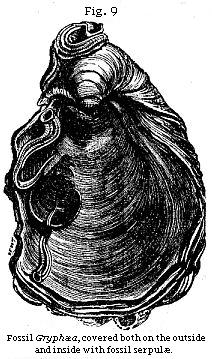
 everywhere
throughout a long series of strata, we can not doubt that time was required for
the multiplication of successive generations; and the evidence of slow
accumulation is rendered more striking from the proofs, so often discovered, of
fossil bodies having lain for a time on the floor of the ocean after death
before they were imbedded in sediment. Nothing, for example, is more common than
to see fossil oysters in clay, with Serpulæ, or barnacles (acorn-shells), or
corals, and other creatures, attached to the inside of the valves, so that the
mollusk was certainly not buried in argillaceous mud the moment it died. There
must have been an interval during which it was still surrounded with clear
water, when the creatures whose remains now adhere to it grew from an embryonic
to a mature state. Attached shells which are merely external, like some of the
Serpulæ (a) in Fig. 9, may often have grown upon an oyster or other shell
while the animal within was still living; but if they are found on the inside,
it could only happen after the death of the inhabitant of the shell which
affords the support. Thus, in Fig. 9, it will be seen that two Serpulæ have
grown on the interior, one of them exactly on the place where the adductor
muscle of the Gryphæa (a kind of oyster) was fixed. everywhere
throughout a long series of strata, we can not doubt that time was required for
the multiplication of successive generations; and the evidence of slow
accumulation is rendered more striking from the proofs, so often discovered, of
fossil bodies having lain for a time on the floor of the ocean after death
before they were imbedded in sediment. Nothing, for example, is more common than
to see fossil oysters in clay, with Serpulæ, or barnacles (acorn-shells), or
corals, and other creatures, attached to the inside of the valves, so that the
mollusk was certainly not buried in argillaceous mud the moment it died. There
must have been an interval during which it was still surrounded with clear
water, when the creatures whose remains now adhere to it grew from an embryonic
to a mature state. Attached shells which are merely external, like some of the
Serpulæ (a) in Fig. 9, may often have grown upon an oyster or other shell
while the animal within was still living; but if they are found on the inside,
it could only happen after the death of the inhabitant of the shell which
affords the support. Thus, in Fig. 9, it will be seen that two Serpulæ have
grown on the interior, one of them exactly on the place where the adductor
muscle of the Gryphæa (a kind of oyster) was fixed.
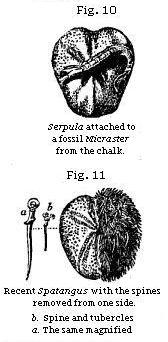
 Some
fossil shells, even if simply attached to the outside of others, bear
full testimony to the conclusion above alluded to, namely, that an interval
elapsed between the death of the creature to whose shell they adhere, and the
burial of the same in mud or sand. The sea-urchins, or Echini, so
abundant in white chalk, afford a good illustration. It is well known that these
animals, when living, are invariably covered with spines supported by rows of
tubercles. These last are only seen after the death of the sea-urchin, when the
spines have dropped off. In Fig. 11 a living species of Spatangus, common
on our coast, is represented with one half of its shell stripped of the spines.
In Fig. 10 a fossil of a similar and allied genus from the white chalk of
England shows the naked surface which the individuals of this family exhibit
when denuded of their bristles. The full-grown Serpula, therefore, which
now adheres externally, could not have begun to grow till the Micraster
had died, and the spines became detached. Some
fossil shells, even if simply attached to the outside of others, bear
full testimony to the conclusion above alluded to, namely, that an interval
elapsed between the death of the creature to whose shell they adhere, and the
burial of the same in mud or sand. The sea-urchins, or Echini, so
abundant in white chalk, afford a good illustration. It is well known that these
animals, when living, are invariably covered with spines supported by rows of
tubercles. These last are only seen after the death of the sea-urchin, when the
spines have dropped off. In Fig. 11 a living species of Spatangus, common
on our coast, is represented with one half of its shell stripped of the spines.
In Fig. 10 a fossil of a similar and allied genus from the white chalk of
England shows the naked surface which the individuals of this family exhibit
when denuded of their bristles. The full-grown Serpula, therefore, which
now adheres externally, could not have begun to grow till the Micraster
had died, and the spines became detached.
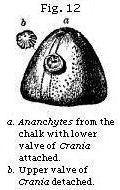
 Now
the series of events here attested by a single fossil may be carried a step
farther. Thus, for example, we often meet with a sea-urchin (Ananchytes)
in the chalk (see Fig. 12) which has fixed to it the lower valve of a Crania,
a genus of bivalve mollusca. The upper valve (b, Fig. 12) is almost
invariably wanting, though occasionally found in a perfect state of preservation
in white chalk at some distance. In this case, we see clearly that the
sea-urchin first lived from youth to age, then died and lost its spines, which
were carried away. Then the young Crania adhered to the bared shell, grew
and perished in its turn; after which the upper valve was separated from the
lower before the Ananchytes became enveloped in chalky mud. Now
the series of events here attested by a single fossil may be carried a step
farther. Thus, for example, we often meet with a sea-urchin (Ananchytes)
in the chalk (see Fig. 12) which has fixed to it the lower valve of a Crania,
a genus of bivalve mollusca. The upper valve (b, Fig. 12) is almost
invariably wanting, though occasionally found in a perfect state of preservation
in white chalk at some distance. In this case, we see clearly that the
sea-urchin first lived from youth to age, then died and lost its spines, which
were carried away. Then the young Crania adhered to the bared shell, grew
and perished in its turn; after which the upper valve was separated from the
lower before the Ananchytes became enveloped in chalky mud.
 It
may be well to mention one more illustration of the manner in which single
fossils may sometimes throw light on a former state of things, both in the bed
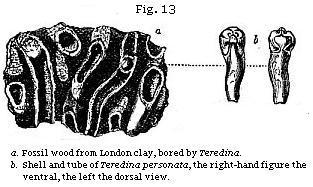
of the ocean and on some adjoining land. We meet with many fragments of wood
bored by ship-worms at various depths in the clay on which London is built.
Entire branches and stems of trees, several feet in length, are sometimes found
drilled all over by the holes of these borers, the tubes and shells of the
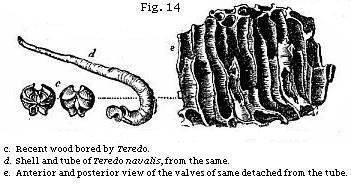
mollusk still remaining in the cylindrical hollows. In Fig. 14, e, a
representation is given of a piece of recent wood pierced by the Teredo
navalis, or common ship-worm, which destroys wooden piles and ships. When
the cylindrical tube d has been extracted from the wood, the valves are
seen at the larger or anterior extremity, as shown at c. In like manner,
a piece of fossil wood (a, Fig. 13) has been perforated by a kindred but
extinct genus, the Teredina of Lamarck. The calcareous tube of this
mollusk was united and, as it were, soldered on to the valves of the shell (b),
which therefore can not be detached from the tube, like the valves of the recent
Teredo. The wood in this fossil specimen is now converted into a stony
mass, a mixture of clay and lime; but it must once have been buoyant and
floating in the sea, when the Teredinæ lived upon, and perforated it.
Again, before the infant colony settled upon the drift wood, part of a tree must
have been floated down to the sea by a river, uprooted, perhaps, by a flood, or
torn off and cast into the waves by the wind: and thus our thoughts are carried
back to a prior period, when the tree grew for years on dry land, enjoying a fit
soil and climate.
[Lyell uses the occurrence of such things, showing clear evidence of
considerable time between death and fossilization, to imply vast amounts of time
throughout the rock record. This need not necessarily be the case. At the start
of the flood there would undoubtedly have been many such shells of dead sea
creatures, pieces of driftwood, etc. since a period of about eighteen hundred
years of tranquility and fecundity had just passed. The extremely violent
conditions following the break-up of the fountains of the deep - exceptionally
powerful earthquakes, enormous tsunamis, etc.- could have led to them being
spread through a considerable volume of sediment. PRS] It
may be well to mention one more illustration of the manner in which single
fossils may sometimes throw light on a former state of things, both in the bed
of the ocean and on some adjoining land. We meet with many fragments of wood
bored by ship-worms at various depths in the clay on which London is built.
Entire branches and stems of trees, several feet in length, are sometimes found
drilled all over by the holes of these borers, the tubes and shells of the
mollusk still remaining in the cylindrical hollows. In Fig. 14, e, a
representation is given of a piece of recent wood pierced by the Teredo
navalis, or common ship-worm, which destroys wooden piles and ships. When
the cylindrical tube d has been extracted from the wood, the valves are
seen at the larger or anterior extremity, as shown at c. In like manner,
a piece of fossil wood (a, Fig. 13) has been perforated by a kindred but
extinct genus, the Teredina of Lamarck. The calcareous tube of this
mollusk was united and, as it were, soldered on to the valves of the shell (b),
which therefore can not be detached from the tube, like the valves of the recent
Teredo. The wood in this fossil specimen is now converted into a stony
mass, a mixture of clay and lime; but it must once have been buoyant and
floating in the sea, when the Teredinæ lived upon, and perforated it.
Again, before the infant colony settled upon the drift wood, part of a tree must
have been floated down to the sea by a river, uprooted, perhaps, by a flood, or
torn off and cast into the waves by the wind: and thus our thoughts are carried
back to a prior period, when the tree grew for years on dry land, enjoying a fit
soil and climate.
[Lyell uses the occurrence of such things, showing clear evidence of
considerable time between death and fossilization, to imply vast amounts of time
throughout the rock record. This need not necessarily be the case. At the start
of the flood there would undoubtedly have been many such shells of dead sea
creatures, pieces of driftwood, etc. since a period of about eighteen hundred
years of tranquility and fecundity had just passed. The extremely violent
conditions following the break-up of the fountains of the deep - exceptionally
powerful earthquakes, enormous tsunamis, etc.- could have led to them being
spread through a considerable volume of sediment. PRS]
Strata of Organic Origin.—It
has been already remarked that there are rocks in the interior of continents, at
various depths in the earth, and at great heights above the sea, almost entirely
made up of the remains of zoophytes and testacea. Such masses may be compared to
modern oyster-beds and coral-reefs; and, like them, the rate of increase must
have been extremely gradual. But there are a variety of stone deposits in the
earth’s crust, now proved to have been derived from plants and animals of which
the organic origin was not suspected until of late years, even by naturalists.
Great surprise was therefore created some years since by the discovery of
Professor Ehrenberg, of Berlin, that a certain kind of siliceous stone, called
tripoli, was entirely composed of millions of the remains of organic beings,
which were formerly referred to microscopic Infusoria, but which are now
admitted to be plants. They abound in rivulets, lakes, and ponds in England and
other countries, and are termed Diatomaceæ by those naturalists who believe in
their vegetable origin. The subject alluded to has long been well-known in the
arts, under the name of infusorial earth or mountain meal, and is used in the
form of powder for polishing stones and metals. It has been procured, among
other places, from the mud of a lake at Dolgelly, in North Wales, and from Bilin,
in Bohemia, in which latter place a single stratum, extending over a wide area,
is no less than fourteen feet thick. This stone, when examined with a powerful
microscope, is found to consist of the siliceous plates or frustules of the
above-figured Diatomaceæ, united together without any visible cement. It is
difficult to convey an idea of their extreme minuteness; but Ehrenberg estimates
that in the Bilin tripoli there are 41,000 millions of individuals of the
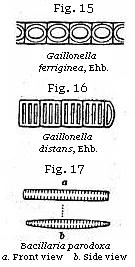
Gaillonella distans (see Fig. 16) in every cubic inch (which weighs about
220 grains), or about 187 millions in a single grain. At every stroke,
therefore, that we make with this polishing powder, several millions, perhaps
tens of millions, of perfect fossils are crushed to atoms.
A well-known substance, called
bog-iron ore, often met with in peat-mosses, has often been shown by Ehrenberg
to consist of innumerable articulated threads, of a yellow ochre colour,
composed of silica, argillaceous matter, and peroxide of iron. These threads are
the cases of a minute microscopic body, called Gaillonella ferruginea
(Fig. 15), associated with the siliceous frustules of other fresh-water algæ.
Layers of this iron ore occurring in Scotch peat bogs are often called “the
pan,” and are sometimes of economical value.
It is clear much time must have
been required for the accumulation of strata to which countless generations of
Diatomaceæ have contributed their remains; and these discoveries lead us
naturally to suspect that other deposits, of which the materials have been
supposed to be inorganic, may in reality be composed chiefly of microscopic
organic bodies. That this is the case with the white chalk, has often been
imagined, and is now proved to be the fact. It has, moreover, been lately
discovered that the chambers into which these Foraminifera are divided are
actually often filled with thousands of well-preserved organic bodies, which
abound in every minute grain of chalk, and are especially apparent in the white
coating of flints, often accompanied by innumerable needle-shaped spiculæ of
sponges (see Chapter XVII).
“The dust we tread upon was
once alive!”—BYRON.
How faint an idea does this
exclamation of the poet convey of the real wonders of nature! for here we
discover proofs that the calcareous and siliceous dust of which hills are
composed has not only been once alive, but almost every particle, albeit
invisible to the naked eye, still retains the organic structure which, at
periods of time incalculably remote, was impressed upon it by the powers of
life. [
Lyell uses the great number of these tiny creatures as a proof of great age.
However, their purity (as also with that of chalk) is a problem for his long
time scale. Today we do not see vast (or even small) volumes of pure diatoms or
foraminifera or oolites being formed. Their remains are mixed with silt and
clay. Such purity suggests "bloom" conditions, where a sudden population
explosion occurs due to unusually favourable circumstances. It is possible that
when the fountains of the deep were broken up volcanic activity led to warm,
carbon dioxide rich water. This could have promoted such blooms. PRS]
Fresh-water and Marine
Fossils.—Strata, whether deposited in salt or fresh water, have the same
forms; but the imbedded fossils are very different in the two cases, because the
aquatic animals which frequent lakes and rivers are distinct from those
inhabiting the sea. In the northern part of the Isle of Wight formations of marl
and limestone, more than 50 feet thick occur, in which the shells are of extinct
species. Yet we recognise their fresh-water origin, because they are of the same
genera as those now abounding in ponds, lakes, and rivers, either in our own
country or in warmer latitudes.
In many parts of France—in
Auvergne, for example—strata occur of limestone, marl, and sandstone hundreds of
feet thick, which contain exclusively fresh-water and land shells, together with
the remains of terrestrial quadrupeds. The number of land-shells scattered
through some of these fresh-water deposits is exceedingly great; and there are
districts in Germany where the rocks scarcely contain any other fossils except
snail-shells (helices); as, for instance, the limestone on the left bank
of the Rhine, between Mayence and Worms, at Oppenheim, Findheim, Budenheim, and
other places. In order to account for this phenomenon, the geologist has only to
examine the small deltas of torrents which enter the Swiss lakes when the waters
are low, such as the newly-formed plain where the Kander enters the Lake of Thun.
He there sees sand and mud strewn over with innumerable dead land-shells, which
have been brought down from the valleys in the Alps in the preceding spring,
during the melting of the snows. Again, if we search the sands on the borders of
the Rhine, in the lower part of its course, we find countless land-shells mixed
with others of species belonging to lakes, stagnant pools, and marshes. These
individuals have been washed away from the alluvial plains of the great river
and its tributaries, some from mountainous regions, others from the low country.
[Shells,
but not fossils, are found today, and on a minute scale compared to the
geological record. Expanding Lyell's reasoning to the huge scale of the flood
can explain the features Lyell is describing. PRS]
 Although
fresh-water formations are often of great thickness, yet they are usually very
limited in area when compared to marine deposits, just as lakes and estuaries
are of small dimensions in comparison with seas. Although
fresh-water formations are often of great thickness, yet they are usually very
limited in area when compared to marine deposits, just as lakes and estuaries
are of small dimensions in comparison with seas.
The absence of many fossil
forms usually met with in marine strata, affords a useful negative indication of
the fresh-water origin of a formation. For example, there are no sea-urchins, no
corals, no chambered shells, such as the nautilus, nor microscopic Foraminifera
in lacustrine or fluviatile deposits. In distinguishing the latter from
formations accumulated in the sea, we are chiefly guided by the forms of the
mollusca. In a fresh-water deposit, the number of individual shells is often as
great as in a marine stratum, if not greater; but there is a smaller variety of
species and genera. This might be anticipated from the fact that the genera and
species of recent fresh-water and land shells are few when contrasted with the
marine. Thus, the genera of true mollusca according to Woodward’s system,
excluding those altogether extinct and those without shells, amount to 446 in
number, of which the terrestrial and fresh-water genera scarcely form more than
a fifth.1
Almost all bivalve shells, or
those of acephalous mollusca, are marine, about sixteen only out of 140 genera
being fresh-water. Among these last, the four most common forms, both recent and
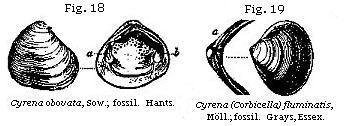
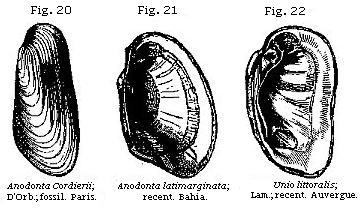
fossil, are Cyclas, Cyrena, Unio, and Anodonta (see Figures); the
two first and two last of which are so nearly allied as to pass into each other.
Lamarck divided the bivalve
mollusca into the Dimyary, or those having two large muscular impressions in
each valve, as a b in the Cyclas, Fig. 18, and Unio, Fig. 22, and the
Monomyary, such as the oyster and scallop, in which there is only one of
these impressions, as is seen in Fig. 23. Now, as none of these last, or the
unimuscular bivalves, are fresh-w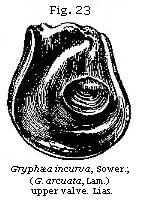 ater,4
we may at once presume a deposit containing any of them to be marine. ater,4
we may at once presume a deposit containing any of them to be marine.
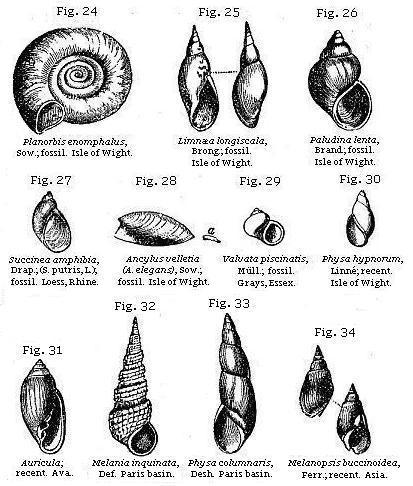
The univalve shells most
characteristic of fresh-water deposits are, Planorbis, Limnæa, and
Paludina. (See Figures.) But to these are occasionally added Physa,
Succinea, Ancylus, Valvata, Melanopsis, Melania, Potamides, and Neritina
(see Figures), the four last being usually found in estuaries.
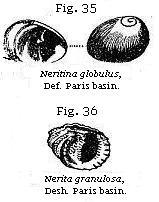
Some naturalists include
Neritina (Fig. 35) and the marine Nerita (Fig. 36) in the same genus,
it being scarcely possible to distinguish the two by good generic characters.
But, as a general rule, the fluviatile species are smaller, smoother, and more
globular than the marine; and they have never, like the Neritæ, the inner
margin of the outer lip toothed or crenulated. (See Fig. 36.)
The Potamides inhabit the
mouths of rivers in warm latitudes, and are distinguishable from the marine
Cerithia by their orbicular and multispiral opercula. The genus Auricula (Fig.
31) is amphibious, frequenting swamps and
 marshes
within the influence of the tide. marshes
within the influence of the tide.
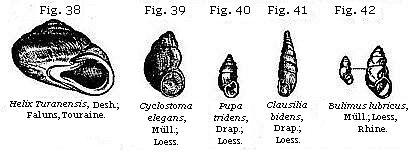
The terrestrial shells are all
univalves. The most important genera among these, both in a recent and fossil
state, are Helix (Fig. 38), Cyclostoma (Fig. 39), Pupa
(Fig. 40), Clausilia (Fig. 41), Bulimus (Fig. 42), Glandina
and Achatina.
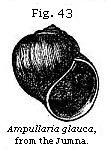
Ampullaria (Fig. 43) is
another genus of shells inhabiting rivers and ponds in hot countries. Many
fossil species formerly referred to this genus, and which have been met with
chiefly in marine formations, are now considered by conchologists to belong to
Natica and other marine genera.
All univalve shells of land
and fresh-water species, with the exception of Melanopsis (Fig. 34), and
Achatina, which has a slight indentation, have entire mouths; and this
circumstance may often serve as a convenient rule for distinguishing fresh-water
from marine strata; since, if any univalves occur of which the mouths are not
entire, we may presume that the formation is marine. The aperture is said to be
entire in such shells as the fresh-water Ampullaria and the land-shells
(Figs 38-42), when its outline is not interrupted by an indentation or notch,
such as that seen at b in Ancillaria (Fig. 45); or is not
prolonged into a canal, as that seen at a in Pleurotoma (Fig.
44).
The
 mouths
of a large proportion of the marine univalves have these notches or canals, and
almost all species are carnivorous; whereas nearly all testacea having entire
mouths are plant-eaters, whether the species be marine, fresh-water, or
terrestrial. mouths
of a large proportion of the marine univalves have these notches or canals, and
almost all species are carnivorous; whereas nearly all testacea having entire
mouths are plant-eaters, whether the species be marine, fresh-water, or
terrestrial.
There is, however, one genus
which affords an occasional exception to one of the above rules. The
Potamides (Fig. 37), a subgenus of Cerithium, although provided with a short
canal, comprises some species which inhabit salt, others brackish, and others
fresh-water, and they are said to be all plant-eaters.
Among the fossils very common
in fresh-water deposits are the shells of Cypris, a minute bivalve
crustaceous animal.3
Many minute living species of this genus swarm in lakes and stagnant pools in
Great Britain; but their shells are not, if considered separately, conclusive as
to the fresh-water origin of a deposit, because the majority of species in
another kindred genus of the same order, the Cytherina of Lamarck,
inhabit salt-water; and, although the animal differs slightly, the shell is
scarcely distinguishable from that o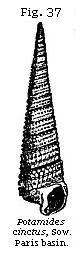 f
the Cypris. f
the Cypris.
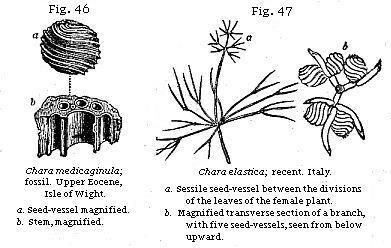
Fresh-water Fossil Plants.—The
seed-vessels and stems of Chara, a genus of aquatic plants, are very
frequent in fresh-water strata. These seed-vessels were called, before their
true nature was known, gyrogonites, and were supposed to be foraminiferous
shells. (See Fig. 46, a.)
The Charæ inhabit the
bottom of lakes and ponds, and flourish mostly where the water is charged with
carbonate of lime. Their seed-vessels are covered with a very tough integument,
capable of resisting decomposition; to which circumstance we may attribute their
abundance in a fossil state. The annexed figure (Fig. 47) represents a branch of
one of many new species found by Professor Amici in the lakes of Northern Italy.
The seed-vessel in this plant is more globular than in the British Charæ,)
and therefore more nearly resembles in form the extinct fossil species found in
England, France, and other countries. The stems, as well as the seed-vessels, of
these plants occur both in modern shell-marl and in ancient fresh-water
formations. They are generally composed of a large central tube surrounded by
smaller ones; the whole stem being divided at certain intervals by transverse
partitions or joints. (See b, Fig. 46.)
It is not uncommon to meet with
layers of vegetable matter, impressions of leaves, and branches of trees, in
strata containing fresh-water shells; and we also find occasionally the teeth
and bones of land quadrupeds, of
 species
now unknown. The manner in which such remains are occasionally carried by rivers
into lakes, especially during floods, has been fully treated of in the
“Principles of Geology.” species
now unknown. The manner in which such remains are occasionally carried by rivers
into lakes, especially during floods, has been fully treated of in the
“Principles of Geology.”
Fresh-water and Marine Fish.—The
remains of fish are occasionally useful in determining the fresh-water origin of
strata. Certain genera, such as carp, perch, pike, and loach (Cyprinus, Perca,
Esox, and Cobitis), as also Lebias, being peculiar to
fresh-water. Other genera contain some fresh-water and some marine species,
 as
Cottus, Mugil, and Anguilla, or eel. The rest are either common to
rivers and the sea, as the salmon; or are exclusively characteristic of
salt-water. The above observations respecting fossil fishes are applicable only
to the more modern or tertiary deposits; for in the more ancient rocks the forms
depart so widely from those of existing fishes, that it is very difficult, at
least in the present state of science, to derive any positive information from
ichthyolites respecting the element in which strata were deposited. as
Cottus, Mugil, and Anguilla, or eel. The rest are either common to
rivers and the sea, as the salmon; or are exclusively characteristic of
salt-water. The above observations respecting fossil fishes are applicable only
to the more modern or tertiary deposits; for in the more ancient rocks the forms
depart so widely from those of existing fishes, that it is very difficult, at
least in the present state of science, to derive any positive information from
ichthyolites respecting the element in which strata were deposited.
The alternation of marine and
fresh-water formations, both on a small and large scale, are facts well
ascertained in geology. When it occurs on a small scale, it may have arisen from
the alternate occupation of certain spaces by river-water and the sea; for in
the flood season the river forces back the ocean and freshens it over a large
area, depositing at the same time its sediment; after which the salt-water again
returns, and, on resuming its former place, brings with it sand, mud, and marine
shells.
There ar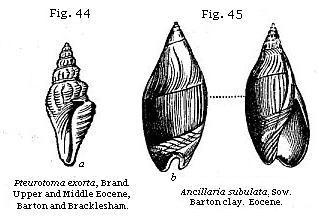 e
also lagoons at the mouth of many rivers, as the Nile and Mississippi, which are
divided off by bars of sand from the sea, and which are filled with salt and
fresh water by turns. They often communicate exclusively with the river for
months, years, or even centuries; and then a breach being made in the bar of
sand, they are for long periods filled with salt-water. e
also lagoons at the mouth of many rivers, as the Nile and Mississippi, which are
divided off by bars of sand from the sea, and which are filled with salt and
fresh water by turns. They often communicate exclusively with the river for
months, years, or even centuries; and then a breach being made in the bar of
sand, they are for long periods filled with salt-water.
Lym-Fiord.—The Lym-Fiord
in Jutland offers an excellent illustration of analogous changes; for, in the
course of the last thousand years, the western extremity of this long frith,
which is 120 miles in length, including its windings, has been four times fresh
and four times salt, a bar of sand between it and the ocean having been often
formed and removed. The last irruption of salt water happened in 1824, when the
North Sea entered, killing all the fresh-water shells, fish, and plants; and
from that time to the present, the sea-weed Fucus vesiculosus, together
with oysters and other marine mollusca, have succeeded the Cyclas, Lymnæa,
Paludina, and Charæ.4
But changes like these in the
Lym-Fiord, and those before mentioned as occurring at the mouths of great
rivers, will only account for some cases of marine deposits of partial extent
resting on fresh-water strata. When we find, as in the south-east of England
(Chapter XVIII), a great series of fresh-water beds, 1000 feet in thickness,
 resting
upon marine formations and again covered by other rocks, such as the Cretaceous,
more than 1000 feet thick, and of deep-sea origin, we shall find it necessary to
seek for a different explanation of the phenomena. resting
upon marine formations and again covered by other rocks, such as the Cretaceous,
more than 1000 feet thick, and of deep-sea origin, we shall find it necessary to
seek for a different explanation of the phenomena.
1 See Woodward’s Manual of
Mollusca, 1856.
2 The fresh-water Mulleria,
when young, forms a single exception to the rule, as it then has two muscular
impressions, but it has only one in the adult state.
3 For figures of fossil species
of Purbeck, see Chapter XIX
4 See Principles, Index, “Lym-Fiord.”
|
|


