|


[~][`] |
Lyell's "The Student's Elements
of Geology"
Chapter 2
AQUEOUS ROCKS.—THEIR
COMPOSITION AND FORMS OF STRATIFICATION.
Introduction:
The Student's Elements of Geology
Chapter 1: On the Different Classes of Rocks
Chapter
2:
Aqueous Rocks
Chapter 3:
Fossils in Strata
Chapter 4:
Consolidation of Strata and Petrifaction
Chapter 5:
Strata Above the Sea
Chapter 6:
Denudation
Mineral Composition of
Strata. — Siliceous Rocks. — Argillaceous. — Calcareous. — Gypsum. — Forms of
Stratification. — Original Horizontality. — Thinning out. — Diagonal
Arrangement. — Ripple-mark.
In pursuance of the arrangement
explained in the last chapter, we shall begin by examining the aqueous or
sedimentary rocks, which are for the most part distinctly stratified, and
contain fossils. We may first study them with reference to their mineral
composition, external appearance, position, mode of origin, organic contents,
and other characters which belong to them as aqueous formations, independently
of their age, and we may afterwards consider them chronologically or with
reference to the successive geological periods when they originated.
I have already given an outline
of the data which led to the belief that the stratified and fossiliferous rocks
were originally deposited under water; but, before entering into a more detailed
investigation, it will be desirable to say something of the ordinary materials
of which such strata are composed. These may be said to belong principally to
three divisions, the siliceous, the argillaceous, and the calcareous, which are
formed respectively of flint, clay, and carbonate of lime. Of these, the
siliceous are chiefly made up of sand or flinty grains; the argillaceous, or
clayey, of a mixture of siliceous matter with a certain proportion, about a
fourth in weight, of aluminous earth; and, lastly, the calcareous rocks, or
limestones, of carbonic acid and lime.
Siliceous and Arenaceous
Rocks.—To speak first of the sandy division: beds of loose sand are
frequently met with, of which the grains consist entirely of silex, which term
comprehends all purely siliceous minerals, as quartz and common flint. Quartz is
silex in its purest form. Flint usually contains some admixture of alumina and
oxide of iron. The siliceous grains in sand are usually rounded, as if by the
action of running water. Sandstone is an aggregate of such grains, which often
cohere together without any visible cement, but more commonly are bound together
by a slight quantity of siliceous or calcareous matter, or by oxide of iron or
clay.
Pure siliceous rocks may be
known by not effervescing when a drop of nitric, sulphuric or other acid is
applied to them, or by the grains not being readily scratched or broken by
ordinary pressure. In nature there is every intermediate gradation, from
perfectly loose sand to the hardest sandstone. In micaceous sandstones
mica is very abundant; and the thin silvery plates into which that mineral
divides are often arranged in layers parallel to the planes of stratification,
giving a slaty or laminated texture to the rock.
When sandstone is
coarse-grained, it is usually called grit. If the grains are rounded, and
large enough to be called pebbles, it becomes a conglomerate or
pudding-stone, which may consist of pieces of one or of many different kinds
of rock. A conglomerate, therefore, is simply gravel bound together by cement.
Argillaceous Rocks.—Clay,
strictly speaking, is a mixture of silex or flint with a large proportion,
usually about one fourth, of alumina, or argil; but in common language, any
earth which possesses sufficient ductility, when kneaded up with water, to be
fashioned like paste by the hand, or by the potter’s lathe, is called a clay;
and such clays vary greatly in their composition, and are, in general, nothing
more than mud derived from the decomposition or wearing down of rocks. The
purest clay found in nature is porcelain clay, or kaolin, which results from the
decomposition of a rock composed of feldspar and quartz, and it is almost always
mixed with quartz. The kaolin of China consists of 71·15 parts of silex, 15·86
of alumine, 1·92 of lime, and 6·73 of water;1
but other porcelain clays differ materially, that of Cornwall being composed,
according to Boase, of nearly equal parts of silica and alumine, with 1 per cent
of magnesia.2
Shale has also the property, like clay, of becoming plastic in water: it is
a more solid form of clay, or argillaceous matter, condensed by pressure. It
always divides into laminæ more or less regular.
One general character of all
argillaceous rocks is to give out a peculiar, earthy odour when breathed upon,
which is a test of the presence of alumine, although it does not belong to pure
alumine, but, apparently, to the combination of that substance with oxide of
iron.‡
Calcareous Rocks.—This
division comprehends those rocks which, like chalk, are composed chiefly of lime
and carbonic acid. Shells and corals are also formed of the same elements, with
the addition of animal matter. To obtain pure lime it is necessary to calcine
these calcareous substances, that is to say, to expose them to heat of
sufficient intensity to drive off the carbonic acid, and other volatile matter.
White chalk is sometimes pure carbonate of lime; and this rock, although usually
in a soft and earthy state, is occasionally sufficiently solid to be used for
building, and even passes into a compact stone, or a stone of which the
separate parts are so minute as not to be distinguishable from each other by the
naked eye.
Many limestones are made up
entirely of minute fragments of shells and coral, or of calcareous sand cemented
together. These last might be called “calcareous sandstones;” but that term is
more properly applied to a rock in which the grains are partly calcareous and
partly siliceous, or to quartzose sandstones, having a cement of carbonate of
lime.
The variety of limestone called
oolite is composed of numerous small egg-like grains, resembling the roe
of a fish, each of which has usually a small fragment of sand as a nucleus,
around which concentric layers of calcareous matter have accumulated.
Any limestone which is
sufficiently hard to take a fine polish is called marble. Many of these
are fossiliferous; but statuary marble, which is also called saccharoid
limestone, as having a texture resembling that of loaf-sugar, is devoid of
fossils, and is in many cases a member of the metamorphic series.
Siliceous limestone is
an intimate mixture of carbonate of lime and flint, and is harder in proportion
as the flinty matter predominates.
The presence of carbonate of
lime in a rock may be ascertained by applying to the surface a small drop of
diluted sulphuric, nitric, or muriatic acid, or strong vinegar; for the lime,
having a greater chemical affinity for any one of these acids than for the
carbonic, unites immediately with them to form new compounds, thereby becoming a
sulphate, nitrate or muriate of lime. The carbonic acid, when thus liberated
from its union with the lime, escapes in a gaseous form, and froths up or
effervesces as it makes its way in small bubbles through the drop of liquid.
This effervescence is brisk or feeble in proportion as the limestone is pure or
impure, or, in other words, according to the quantity of foreign matter mixed
with the carbonate of lime. Without the aid of this test, the most experienced
eye can not always detect the presence of carbonate of lime in rocks.
The above-mentioned three classes of rocks, the siliceous, argillaceous, and
calcareous, pass continually into each other, and rarely occur in a perfectly
separate and pure form. Thus it is an exception to the general rule to meet with
a limestone as pure as ordinary white chalk, or with clay as aluminous as that
used in Cornwall for porcelain, or with sand so entirely composed of siliceous
grains as the white sand of Alum Bay, in the Isle of Wight, employed in the
manufacture of glass, or sandstone so pure as the grit of Fontainebleau, used
for pavement in France. More commonly we find sand and clay, or clay and marl,
intermixed in the same mass. When the sand and clay are each in considerable
quantity, the mixture is called loam. If there is much calcareous matter
in clay it is called marl; but this term has unfortunately been used so
vaguely, as often to be very ambiguous. It has been applied to substances in
which there is no lime; as, to that red loam usually called red marl in certain
parts of England. Agriculturists were in the habit of calling any soil a marl
which, like true marl, fell to pieces readily on exposure to the air. Hence
arose the confusion of using this name for soils which, consisting of loam, were
easily worked by the plough, though devoid of lime.
Marl slate bears the
same relation to marl which shale bears to clay, being a calcareous shale. It is
very abundant in some countries, as in the Swiss Alps. Argillaceous or marly
limestone is also of common occurrence.
There are few other kinds of
rock which enter so largely into the composition of sedimentary strata as to
make it necessary to dwell here on their characters. I may, however, mention two
others—magnesian limestone or dolomite, and gypsum. Magnesian limestone
is composed of carbonate of lime and carbonate of magnesia; the proportion of
the latter amounting in some cases to nearly one half. It effervesces much more
slowly and feebly with acids than common limestone. In England this rock is
generally of a yellowish colour; but it varies greatly in mineralogical
character, passing from an earthy state to a white compact stone of great
hardness. Dolomite, so common in many parts of Germany and France, is
also a variety of magnesian limestone, usually of a granular texture.
Gypsum is a rock
composed of sulphuric acid, lime, and water. It is usually a soft whitish-yellow
rock, with a texture resembling that of loaf-sugar, but sometimes it is entirely
composed of lenticular crystals. It is insoluble in acids, and does not
effervesce like chalk and dolomite, because it does not contain carbonic acid
gas, or fixed air, the lime being already combined with sulphuric acid, for
which it has a stronger affinity than for any other. Anhydrous gypsum is a rare
variety, into which water does not enter as a component part. Gypseous marl
is a mixture of gypsum and marl. Alabaster is a granular and compact
variety of gypsum found in masses large enough to be used in sculpture and
architecture. It is sometimes a pure snow-white substance, as that of Volterra
in Tuscany, well known as being carved for works of art in Florence and Leghorn.
It is a softer stone than marble, and more easily wrought.
Forms of Stratification.—A
series of strata sometimes consists of one of the above rocks, sometimes of two
or more in alternating beds.
Thus, in the coal districts of
England, for example, we often pass through several beds of sandstone, some of
finer, others of coarser grain, some white, others of a dark colour, and below
these, layers of shale and sandstone or beds of shale, divisible into leaf-like
laminæ, and containing beautiful impressions of plants. Then again we meet with
beds of pure and impure coal, alternating with shales and sandstones, and
underneath the whole, perhaps, are calcareous strata, or beds of limestone,
filled with corals and marine shells, each bed distinguishable from another by
certain fossils, or by the abundance of particular species of shells or
zoophytes.
This alternation of different
kinds of rock produces the most distinct stratification; and we often find beds
of limestone and marl, conglomerate and sandstone, sand and clay, recurring
again and again, in nearly regular order, throughout a series of many hundred
strata. The causes which may produce these phenomena are various, and have been
fully discussed in my treatise on the modern changes of the earth’s surface.* It
is there seen that rivers flowing into lakes and seas are charged with sediment,
varying in quantity, composition, colour, and grain according to the seasons;
the waters are sometimes flooded and rapid, at other periods low and feeble;
different tributaries, also, draining peculiar countries and soils, and
therefore charged with peculiar sediment, are swollen at distinct periods. It
was also shown that the waves of the sea and currents undermine the cliffs
during wintry storms, and sweep away the materials into the deep, after which a
season of tranquillity succeeds, when nothing but the finest mud is spread by
the movements of the ocean over the same submarine area.
It is not the object of the
present work to give a description of these operations, repeated as they are,
year after year, and century after century; but I may suggest an explanation of
the manner in which some micaceous sandstones have originated, namely, those in
which we see innumerable thin layers of mica dividing layers of fine quartzose
sand. I observed the same arrangement of materials in recent mud deposited in
the estuary of Laroche St. Bernard in Brittany, at the mouth of the Loire. The
surrounding rocks are of gneiss, which, by its waste, supplies the mud: when
this dries at low water, it is found to consist of brown laminated clay, divided
by thin seams of mica. The separation of the mica in this case, or in that of
micaceous sandstones, may be thus understood. If we take a handful of quartzose
sand, mixed with mica, and throw it into a clear running stream, we see the
materials immediately sorted by the water, the grains of quartz falling almost
directly to the bottom, while the plates of mica take a much longer time to
reach the bottom, and are carried farther down the stream. At the first instant
the water is turbid, but immediately after the flat surfaces of the plates of
mica are seen all alone, reflecting a silvery light, as they descend slowly, to
form a distinct micaceous lamina. The mica is the heavier mineral of the two;
but it remains a longer time suspended in the fluid, owing to its greater extent
of surface. It is easy, therefore, to perceive that where such mud is acted upon
by a river or tidal current, the thin plates of mica will be carried farther,
and not deposited in the same places as the grains of quartz; and since the
force and velocity of the stream varies from time to time, layers of mica or of
sand will be thrown down successively on the same area.
[Note that Lyell relates the observed phenomena to flowing water and he
mentions observations in rivers and estuaries. His time scale, however, was
worked out for deep ocean deposition rates. PRS]
Original Horizontality.—It
is said generally that the upper and under surfaces of strata, or the “planes of
stratification,” are parallel. Although this is not strictly true, they make an
approach to parallelism, for the same reason that sediment is usually deposited
at first in nearly horizontal layers. [Note this is one
of the assumptions (rarely stated to be an assumption), which was disproved by
the experiments of Guy Berhault. PRS] Such an arrangement can by no
means be attributed to an original evenness or horizontality in the bed of the
sea: for it is ascertained that in those places where no matter has been
recently deposited, the bottom of the ocean is often as uneven as that of the
dry land, having in like manner its hills, valleys, and ravines. Yet if the sea
should go down, or be removed from near the mouth of a large river where a delta
has been forming, we should see extensive plains of mud and sand laid dry,
which, to the eye, would appear perfectly level, although, in reality, they
would slope gently from the land towards the sea.
This tendency in newly-formed
strata to assume a horizontal position arises principally from the motion of the
water, which forces along particles of sand or mud at the bottom, and causes
them to settle in hollows or depressions where they are less exposed to the
force of a current than when they are resting on elevated points. The velocity
of the current and the motion of the superficial waves diminish from the surface
downward, and are least in those depressions where the water is deepest.
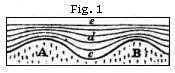
A good illustration of the
principle here alluded to may be sometimes seen in the neighbourhood of a
volcano, when a section, whether natural or artificial, has laid open to view a
succession of various-coloured layers of sand and ashes, which have fallen in
showers upon uneven ground. Thus let A B (Fig. 1) be . These original
inequalities of the surface have been gradually effaced by beds of sand and
ashes c, d, e, the surface at e being quite level. It will be seen
that, although the materials of the first layers have accommodated themselves in
a great degree to the shape of the ground A B, yet each bed is thickest at the
bottom. At first a great many particles would be carried by their own gravity
down the steep sides of A and B, and others would afterwards be blown by the
wind as they fell off the ridges, and would settle in the hollow, which would
thus become more and more effaced as the strata accumulated from c to
e. Now, water in motion can exert this levelling power on similar materials
more easily than air, for almost all stones lose in water more than a third of
the weight which they have in air, the specific gravity of rocks being in
general as 2½ when compared to that of water, which is estimated at 1. But the
buoyancy of sand or mud would be still greater in the sea, as the density of
salt-water exceeds that of fresh.
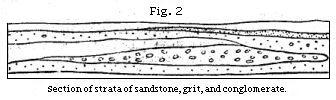
Yet, however uniform and
horizontal may be the surface of new deposits in general, there are still many
disturbing causes, such as eddies in the water, and currents moving first in one
and then in another direction, which frequently cause irregularities. We may
sometimes follow a bed of limestone, shale, or sandstone, for a distance of many
hundred yards continuously; but we generally find at length that each individual
stratum thins out, and allows the beds which were previously above and below it
to meet. If the materials are coarse, as in grits and conglomerates, the same
beds can rarely be traced many yards without varying in size, and often coming
to an end abruptly. (See Fig. 2.)
Diagonal or Cross
Stratification.—There is also another ph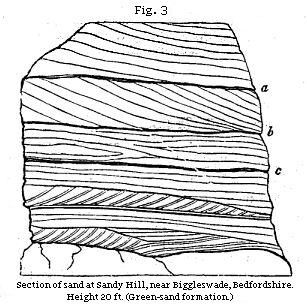 enomenon
of frequent occurrence. We find a series of larger strata, each of which is
composed of a number of minor layers placed obliquely to the general planes of
stratification. To this diagonal arrangement the name of “false or cross
bedding” has been given. Thus in the section (Fig. 3) we see seven or eight
large beds of loose sand, yellow and brown, and the lines a, b, c mark
some of the principal planes of stratification, which are nearly horizontal. But
the greater part of the subordinate laminæ do not conform to these planes, but
have often a steep slope, the inclination being sometimes towards opposite
points of the compass. When the sand is loose and incoherent, as in the case
here represented, the deviation from parallelism of the slanting laminæ can not
possibly be accounted for by any rearrangement of the particles acquired during
the consolidation of the rock. In what manner, then, can such irregularities
be due to original deposition? We must suppose that at the bottom of the sea, as
well as in the beds of rivers, the motions of waves, currents, and eddies often
cause mud, sand, and gravel to be thrown down in heaps on particular spots,
instead of being spread out uniformly over a wide area. Sometimes, when banks
are thus formed, currents may cut passages through them, just as a river forms
its bed. enomenon
of frequent occurrence. We find a series of larger strata, each of which is
composed of a number of minor layers placed obliquely to the general planes of
stratification. To this diagonal arrangement the name of “false or cross
bedding” has been given. Thus in the section (Fig. 3) we see seven or eight
large beds of loose sand, yellow and brown, and the lines a, b, c mark
some of the principal planes of stratification, which are nearly horizontal. But
the greater part of the subordinate laminæ do not conform to these planes, but
have often a steep slope, the inclination being sometimes towards opposite
points of the compass. When the sand is loose and incoherent, as in the case
here represented, the deviation from parallelism of the slanting laminæ can not
possibly be accounted for by any rearrangement of the particles acquired during
the consolidation of the rock. In what manner, then, can such irregularities
be due to original deposition? We must suppose that at the bottom of the sea, as
well as in the beds of rivers, the motions of waves, currents, and eddies often
cause mud, sand, and gravel to be thrown down in heaps on particular spots,
instead of being spread out uniformly over a wide area. Sometimes, when banks
are thus formed, currents may cut passages through them, just as a river forms
its bed.
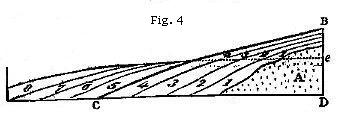
Suppose the bank A (Fig. 4) to
be thus formed with a steep sloping side, and, the water being in a tranquil
state, the layer of sediment No. 1 is thrown down upon it, conforming nearly to
its surface. Afterwards the other layers, 2, 3, 4, may be deposited in
succession, so that the bank B C D is formed. If the current then increases in
velocity, it may cut away the upper portion of this mass down to the dotted line
e, and deposit the materials thus removed farther on, so as to form the layers
5, 6, 7, 8.
We have now the bank B, C, D, E
(Fig. 5), of which the
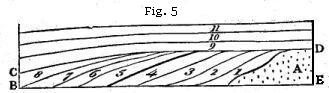 surface
is almost level, and on which the nearly horizontal layers, 9, 10, 11, may then
accumulate. It was shown in Fig. 3 that the diagonal layers of successive strata
may sometimes have an opposite slope. This is well seen in some cliffs of loose
sand on the Suffolk coast. surface
is almost level, and on which the nearly horizontal layers, 9, 10, 11, may then
accumulate. It was shown in Fig. 3 that the diagonal layers of successive strata
may sometimes have an opposite slope. This is well seen in some cliffs of loose
sand on the Suffolk coast.
A portion of one of these is
represented in Fig. 6, where the l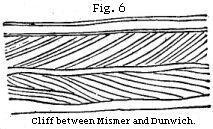 ayers,
of which there are about six in the thickness of an inch, are composed of
quartzose grains. This arrangement may have been due to the altered direction of
the tides and currents in the same place. [If the time
scale Lyell worked out based on deep ocean deposition rates were applied, then
such variations would be invisible. Lyell's deposition rate (about one eighth
of an inch per century), means the deposition during a tide change would be
microscopic. I personally have seen beds of Dogger Sandstone where this bedding
is in layers about one foot thick. On the usual interpretation that the reversed
slope is due to the ebb and flow of tides, this would imply a deposition rate of
about two feet per day. Even in the example Lyell chooses here the rate would be
one third of an inch per day. PRS] ayers,
of which there are about six in the thickness of an inch, are composed of
quartzose grains. This arrangement may have been due to the altered direction of
the tides and currents in the same place. [If the time
scale Lyell worked out based on deep ocean deposition rates were applied, then
such variations would be invisible. Lyell's deposition rate (about one eighth
of an inch per century), means the deposition during a tide change would be
microscopic. I personally have seen beds of Dogger Sandstone where this bedding
is in layers about one foot thick. On the usual interpretation that the reversed
slope is due to the ebb and flow of tides, this would imply a deposition rate of
about two feet per day. Even in the example Lyell chooses here the rate would be
one third of an inch per day. PRS]
The description above given of
the slanting position of the minor layers constituting a single stratum is in
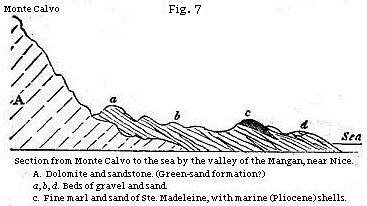 certain
cases applicable on a much grander scale to masses several hundred feet thick,
and many miles in extent. A fine example may be seen at the base of the Maritime
Alps near Nice. The mountains here terminate abruptly in the sea, so that a
depth of one hundred fathoms is often found within a stone’s throw of the beach,
and sometimes a depth of 3000 feet within half a mile. But at certain points,
strata of sand, marl, or conglomerate intervene between the shore and the
mountains, as in the section (Fig. 7), where a vast succession of slanting beds
of gravel and sand may be traced from the sea to Monte Calvo, a distance of no
less than nine miles in a straight line. The dip of these beds is remarkably
uniform, being always southward or towards the Mediterranean, at an angle of
about 25°. They are exposed to view in nearly vertical precipices, varying from
200 to 600 feet in height, which bound the valley through which the river Magnan
flows. Although, in a general view, the strata appear to be parallel and
uniform, they are nevertheless found, when examined closely, to be wedge-shaped,
and to thin out when followed for a few hundred feet or yards, so that we may
suppose them to have been thrown down originally upon the side of a steep bank
where a river or Alpine torrent discharged itself into a deep and tranquil sea,
and formed a delta, which advanced gradually from the base of Monte Calvo to a
distance of nine miles from the original shore. If subsequently this part of the
Alps and bed of the sea were raised 700 feet, the delta may have emerged, a deep
channel may then have been cut through it by the river, and the coast may at the
same time have acquired its present configuration. certain
cases applicable on a much grander scale to masses several hundred feet thick,
and many miles in extent. A fine example may be seen at the base of the Maritime
Alps near Nice. The mountains here terminate abruptly in the sea, so that a
depth of one hundred fathoms is often found within a stone’s throw of the beach,
and sometimes a depth of 3000 feet within half a mile. But at certain points,
strata of sand, marl, or conglomerate intervene between the shore and the
mountains, as in the section (Fig. 7), where a vast succession of slanting beds
of gravel and sand may be traced from the sea to Monte Calvo, a distance of no
less than nine miles in a straight line. The dip of these beds is remarkably
uniform, being always southward or towards the Mediterranean, at an angle of
about 25°. They are exposed to view in nearly vertical precipices, varying from
200 to 600 feet in height, which bound the valley through which the river Magnan
flows. Although, in a general view, the strata appear to be parallel and
uniform, they are nevertheless found, when examined closely, to be wedge-shaped,
and to thin out when followed for a few hundred feet or yards, so that we may
suppose them to have been thrown down originally upon the side of a steep bank
where a river or Alpine torrent discharged itself into a deep and tranquil sea,
and formed a delta, which advanced gradually from the base of Monte Calvo to a
distance of nine miles from the original shore. If subsequently this part of the
Alps and bed of the sea were raised 700 feet, the delta may have emerged, a deep
channel may then have been cut through it by the river, and the coast may at the
same time have acquired its present configuration.
It is well known that the
torrents and streams which now descend from the Alpine declivities to the shore,
bring down annually, when the snow melts, vast quantities of shingle and sand,
and then, as they subside, fine mud, while in summer they are nearly or entirely
dry; so that it may be safely assumed that deposits like those of the valley of
the Magnan, consisting of coarse gravel alternating with fine sediment, are
still in progress at many points, as, for instance, at the mouth of the Var.
They must advance upon the Mediterranean in the form of great shoals terminating
in a steep talus; such being the original mode of accumulation of all coarse
materials conveyed into deep water, especially where they are composed in great
part of pebbles, which can not be transported to indefinite distances by
currents of moderate velocity. By inattention to facts and inferences of this
kind, a very exaggerated estimate has sometimes been made of the supposed depth
of the ancient ocean. There can be no doubt, for example, that the strata a,
Fig. 7, or those nearest to Monte Calvo, are older than those indicated by b,
and these again were formed before c; but the vertical depth of gravel
and sand in any one place can not be proved to amount even to 1000 feet,
although it may perhaps be much greater, yet probably never exceeding at any
point 3000 or 4000 feet. But were we to assume that all the strata were once
horizontal, and that their present dip or inclination was due to subsequent
movements, we should then be forced to conclude that a sea several miles deep
had been filled up with alternate layers of mud and pebbles thrown down one upon
another.
In the locality now under
consideration, situated a few miles to the west of Nice, there are many
geological data, the details of which can not be given in this place, all
leading to the opinion that, when the deposit of the Magnan was formed, the
shape and outline of the Alpine declivities and the shore greatly resembled what
we now behold at many points in the neighbourhood. That the beds a, b, c, d
are of comparatively modern date is proved by this fact, that in seams of loamy
marl intervening between the pebbly beds are fossil shells, half of which belong
to species now living in the Mediterranean.
Ripple-mark.—The
ripple-mark, so common on the surface of s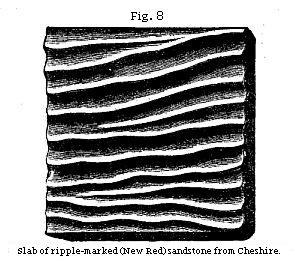 andstones
of all ages (see Fig. 8), and which is so often seen on the sea-shore at low
tide, seems to originate in the drifting of materials along the bottom of the
water, in a manner very similar to that which may explain the inclined layers
above described. This ripple is not entirely confined to the beach between high
and low water mark, but is also produced on sands which are constantly covered
by water. Similar undulating ridges and furrows may also be sometimes seen on
the surface of drift snow and blown sand. andstones
of all ages (see Fig. 8), and which is so often seen on the sea-shore at low
tide, seems to originate in the drifting of materials along the bottom of the
water, in a manner very similar to that which may explain the inclined layers
above described. This ripple is not entirely confined to the beach between high
and low water mark, but is also produced on sands which are constantly covered
by water. Similar undulating ridges and furrows may also be sometimes seen on
the surface of drift snow and blown sand.
The ripple-mark is usually an
indication of a sea-beach, or of water from six to ten feet deep, for the
agitation caused by waves even during storms extends to a very slight depth. To
this rule, however, there are some exceptions, and recent ripple-marks have been
observed at the depth of 60 or 70 feet. It has also been ascertained that
currents or large bodies of water in motion may disturb mud and sand at the
depth of 300 or even 450 feet.* Beach ripple, however, may usually be
distinguished from current ripple by frequent changes in its direction. In a
slab of sandstone, not more than an inch thick, the furrows or ridges of an
ancient ripple may often be seen in several successive laminæ to run towards
different points of the compass.
1 Darwin,
Volcanic Islands, p. 134.
2 W.
Phillips, Mineralogy, p.33.
3 Phil.
Mag., vol. x, 1837.
4 See W.
Phillips’s Mineralogy, “Alumine.”
5 Consult
Index to Principles of Geology, “Stratification,” “Currents,” “Deltas,” “Water,”
etc.
|
|


